Recent benchmarks have shed new light on AMD’s FidelityFX Super Resolution 4 (FSR 4) performance when running on older GPU architectures like RDNA 2 and RDNA 3. While AMD’s newest Radeon RX 9000 series (RDNA 4) graphics cards are the only ones officially designed to support FSR 4 with the advanced FP8 data format, many enthusiasts have been experimenting with an unofficial INT8 variant that enables compatibility with earlier hardware generations. 
The results, however, come with trade-offs – particularly a measurable performance penalty averaging around 10% compared to the official version.
FSR 4 represents AMD’s most ambitious iteration of its upscaling technology to date, pushing the limits of temporal reconstruction and frame generation to deliver crisper visuals and higher frame rates. But because RDNA 2 and RDNA 3 lack FP8 instruction support, modders turned to AMD’s leaked INT8 model files to make the technology work through a custom implementation. On paper, the results appear promising: gamers can experience most of FSR 4’s visual fidelity, but the performance impact cannot be ignored.
According to ComputerBase’s latest testing, which compared RDNA 2, RDNA 3, and the newer RDNA 4 GPUs, the gap becomes clearer under controlled benchmarks. Using the Radeon RX 7800 XT and RX 6800 XT as representatives of RDNA 3 and RDNA 2 respectively, the site compared their results against the officially supported RX 9060 XT. On average, while the RDNA 4 GPU experienced only a modest 3% frame rate dip when moving from FSR 3.1 to FSR 4 in Quality mode at 1440p resolution, the older GPUs showed performance losses closer to 9–10% with the unofficial INT8 version.
The visual quality story is more nuanced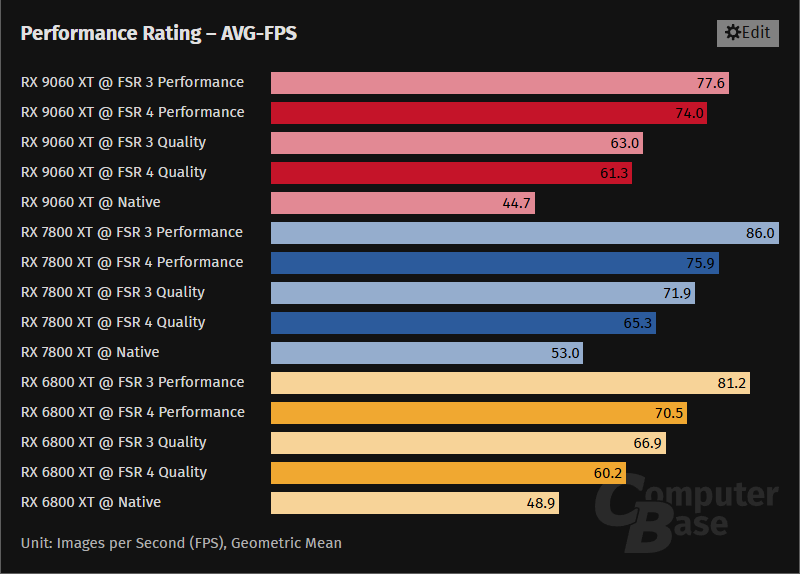
. FSR 4 using FP8 delivers subtly better detail, improved motion clarity, and sharper edges in most cases. However, the INT8 version isn’t far behind – in some games, it can even appear nearly identical to the trained eye. Yet, this comes at the expense of consistent frame pacing and average FPS. When comparing Quality and Performance presets, FSR 4 INT8 on the RX 7800 XT and RX 6800 XT showed occasional improvements in select cases, such as up to 5% gains in raw FPS over FSR 3.1 Performance, but across multiple scenes, the overall deficit remained significant, often between 10–13% depending on rendering load and engine type.
These findings align with previous community reports suggesting that while the FSR 4 INT8 variant enhances visual presentation, it can’t match the smooth gameplay provided by official RDNA 4 hardware. The limitation lies in the older architecture’s inability to natively handle FP8 precision operations efficiently, forcing less optimized INT8 fallbacks that cost GPU cycles. This may not bother every gamer – especially those chasing better fidelity over frame rate – but for competitive or performance-driven players, the trade-off is hard to justify.
Currently, AMD has not confirmed plans to release an official INT8-compatible version of FSR 4 for RDNA 3 or RDNA 2 GPUs. Given how popular these architectures remain in the gaming market, many are hoping AMD will optimize and sanction a version that reduces the performance loss without sacrificing the enhanced image quality. Until then, early adopters experimenting with the leaked INT8 build will continue to balance beauty against speed, pushing their older Radeon cards just a little beyond what AMD officially intended.
3 comments
same old amd story, half baked features for older cards 😒
visuals are nice but feels stuttery, i’ll stick to fsr3
amd should just release official support, too many ppl using rdna3 rn