Samsung’s long-secret Project Moohan has finally taken shape, and the curtain is lifting on what might become one of the most ambitious products in the XR (extended reality) landscape – the Samsung Galaxy XR headset. Weeks ahead of its expected launch, a massive leak has poured out virtually every detail: dual 4K micro-OLED panels, Qualcomm’s new Snapdragon XR2+ Gen 2 chip, and Google Gemini AI integration. What was once only speculation has now crystallized into a headset that could redefine how Android users experience mixed reality.
The leak, published by Android Headlines, unveils an ecosystem designed not merely to imitate Apple’s Vision Pro but to challenge it head-on. 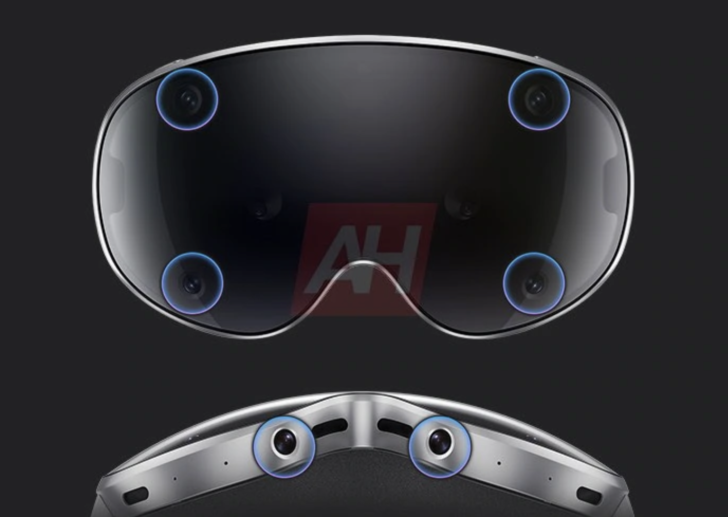
The Galaxy XR reportedly merges comfort, visual excellence, and a more open AI-powered interface into one futuristic package. With this, Samsung appears ready to reclaim the innovation narrative it once held in the Gear VR era – but now, with hardware that rivals Apple’s cutting-edge devices.
A Design Focused on Comfort and Immersion
The first impression of the Galaxy XR is strikingly refined – a blend of minimalism and engineering precision. The headset features a curved front visor and a matte metallic frame that radiate premium quality. Its 545-gram weight makes it notably lighter than Apple’s Vision Pro, suggesting Samsung prioritized long-session comfort. A rear tension dial allows users to find their ideal fit, while ventilation channels and detachable light shields help balance immersion with breathability. The design signals a clear message: this headset was built for everyday usability, not just short demo sessions.
Samsung’s engineers also introduced modular design choices that enthusiasts will appreciate – detachable components for light isolation, adjustable straps, and carefully balanced weight distribution. Compared to the Vision Pro, which some users have found heavy over time, Samsung’s design looks distinctly practical and comfort-oriented.
4K Micro-OLED Brilliance and Powerful Performance
Display quality has always been Samsung’s playground, and the Galaxy XR may well set a new bar. The headset reportedly houses dual 4K micro-OLED displays delivering a staggering 4,032 pixels per inch – exceeding the Vision Pro’s 3,386 PPI. This density translates into unprecedented clarity, where even fine text and textures appear razor-sharp. Samsung claims users will experience true 3D immersion with vibrant color accuracy and deep contrast ratios rivaling professional-grade monitors.
Under the hood, the Galaxy XR runs on Qualcomm’s Snapdragon XR2+ Gen 2 – a processor built specifically for high-resolution mixed reality. It can push 4.3K resolution at 90 frames per second per eye while managing the complex demands of spatial rendering. Early benchmarks may not rival Apple’s M2 or M5 chips in sheer power, but Samsung’s optimization and Android integration might compensate with efficiency and openness. The trade-off could appeal to developers and users seeking flexibility over raw horsepower.
Intelligent Tracking and AI-Driven Experience
Equipped with a six-camera array, the Galaxy XR offers real-time passthrough, spatial tracking, and environmental mapping. The addition of AI-powered hand and eye tracking allows for intuitive navigation without constantly relying on controllers. Google’s Gemini AI plays a major role here – serving as both an assistant and a contextual layer for spatial computing. Imagine saying, “Show me nearby restaurants,” and having floating 3D windows of Google Maps and Photos appear instantly in front of you. It’s the seamless fusion of Google’s ecosystem with XR that might give Samsung a significant edge.
Software Built for Spatial Android
The headset runs Samsung’s One UI XR, a spatial version of the familiar smartphone interface. Screenshots from the leak show 3D-floating versions of YouTube, Netflix, Chrome, and Maps. A persistent bar integrates Google Gemini AI, system shortcuts, and multitasking – making it feel like an evolution of Android itself, rather than a separate experimental platform. The idea is to make XR computing feel as natural as using a smartphone, but in a space where apps and media exist in three dimensions.
Samsung’s inclusion of 6-DoF controllers (degrees of freedom) equipped with analog sticks, triggers, and haptics ensures precise input for gaming and productivity alike. However, the headset also supports full hand gestures and voice control, letting users ditch controllers entirely when preferred. Detachable light shields reduce glare, emphasizing immersion in darker environments.
Battery, Connectivity, and Launch Details
In terms of endurance, the Galaxy XR delivers around two hours of active use or 2.5 hours of video playback – on par with industry norms for high-end headsets. Connectivity is cutting-edge, featuring Wi-Fi 7 and Bluetooth 5.3. Audio immersion is handled by dual two-way speakers that create directional, spatial sound without needing external headphones.
The expected launch date falls around October 21–22, with pre-registrations opening earlier in the month. Pricing will reportedly range between $1,800 and $2,000 – a serious but competitive offer compared to Apple’s $3,499 Vision Pro. It’s clear Samsung aims to undercut Apple’s dominance while still maintaining premium positioning. Whether that gamble pays off will depend on how well the software ecosystem supports developers and content creators.
Specifications Overview
- Display: Dual 4K micro-OLED panels (4,032 PPI, 29 million pixels total)
- Processor: Qualcomm Snapdragon XR2+ Gen 2
- Software: Samsung One UI XR (spatial 3D interface)
- Audio: Dual two-way spatial speakers
- Sensors: Hand, eye, and voice tracking
- Controllers: Two 6-DoF XR controllers with haptics
- Battery: 2 hours of general use / 2.5 hours video playback
- Weight: 545g
- Connectivity: Wi-Fi 7, Bluetooth 5.3
In summary, Samsung’s Galaxy XR could mark the beginning of a real XR battle between Apple’s closed, performance-heavy approach and Android’s open, AI-infused vision of mixed reality. For the first time in years, Samsung seems poised not to follow – but to lead.
4 comments
At least it’s lighter than Vision Pro… my neck still hurts from that demo lol
Hope they price it right cause $2k for Android headset is wild
If they pull off stable eye tracking + AI control, I’m in day one
I love Samsung hardware but software updates scare me, 6 months and it’s forgotten 😅