ARM Reinvents Its CPU and GPU Cores: Meet the C1 and G1 Lumex Generation
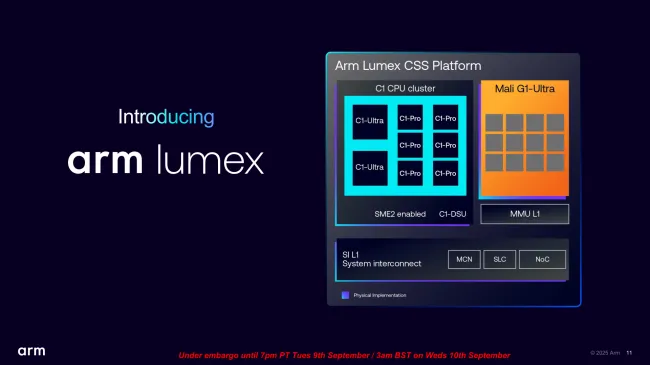
ARM has taken a bold step forward in its processor roadmap, not only by unveiling its latest CPU and GPU architectures but also by completely overhauling its branding. The long-familiar “Cortex” moniker, which has defined ARM chips for more than a decade, is now retired. In its place comes a new, cleaner, and more product-like naming structure: ARM C1 CPUs and ARM G1 GPUs, all under a new umbrella called the ARM Lumex Compute Subsystem (CSS) for mobile. Different markets will see their own names too – “Niva” for PCs, “Zena” for automotive, and more, signaling a shift toward market-specific identities.
The decision to refresh branding is more than a marketing play. ARM wants consumers and manufacturers alike to better distinguish between chip families, their features, and their intended markets. This rebranding pairs with a significant architectural update – the arrival of ARMv9.3, SME2 extensions for AI, and an improved balance of power efficiency and raw performance. In other words, this isn’t just a new nameplate slapped onto old technology. It’s a generational leap designed for the workloads that dominate modern devices: AI, immersive graphics, video, gaming, and always-connected experiences.
The New CPU Family: From Ultra to Nano
The ARM C1 CPU lineup completely replaces the Cortex-X and Cortex-A families, bringing new tiers and roles:
- ARM C1-Ultra – replacing Cortex-X, this flagship class delivers the highest instructions per cycle (IPC), focused on raw single-threaded speed. ARM claims it is up to 25% faster than the Cortex-X925 in single-threaded benchmarks, which translates into faster app launches, smoother UI, and snappier gaming.
- ARM C1-Premium – a brand-new tier designed for sub-flagship chips. It has a 35% smaller silicon footprint than Ultra cores, making it more affordable while still offering exceptional performance-per-mm². This balance makes it ideal for upper-midrange SoCs.
- ARM C1-Pro – taking over the Cortex-A7xx lineage, this is the workhorse core for high-performance and mid-tier designs. Compared with the Cortex-A725, it boosts gaming performance by up to 16% or saves 12% power for tasks like video playback and social browsing.
- ARM C1-Nano – the evolution of Cortex-A5xx, optimized almost entirely for efficiency. With 26% better power savings than Cortex-A520 and a slightly smaller footprint, Nano cores are ideal for background tasks, standby, and ultra-efficient designs.
The cores are tied together by the C1-DynamIQ Shared Unit (DSU), which manages cache sharing, scheduling, and power distribution. The new DSU can deliver up to 26% system-wide power savings compared to the DSU-120.
Designers have flexibility: clusters can scale from as few as one to as many as 14 cores, mixing up to three types of cores. ARM says real-world clusters average a 30% performance uplift on industry benchmarks and 15% faster speeds in gaming and streaming, all while using about 12% less energy.
AI at the Heart: SME2 Extensions
AI is no longer an afterthought in chip design – it’s the centerpiece. All C1 cores natively support Scalable Matrix Extension 2 (SME2), enabling faster execution of matrix-heavy operations. The benefits are dramatic: up to 4.7x lower latency in speech recognition (Whisper Base), 4.7x boosts for Google’s Gemma 3 model, and nearly 3x faster audio generation in Stability AI’s models. Crucially, SME2 is already integrated into major AI frameworks like TensorFlow, PyTorch, and those from Microsoft, Meta, Google, and Alibaba, meaning app developers don’t need to code specifically for it to benefit.
This seamless integration could prove transformative for mobile AI, where processing has traditionally lagged behind cloud-based inference. From real-time transcription to advanced camera features and generative AI tools on-device, SME2 is the architecture designed to make AI personal and immediate.
The New GPU Era: ARM Mali G1 Series
ARM’s GPU architecture is also getting its first major rebrand, shifting from Mali and Immortalis names to the streamlined Mali G1 family. The flagship Mali G1-Ultra integrates the second-generation Ray Tracing Unit (RTUv2), doubling ray tracing performance over Immortalis-G925. Real-world gaming sees up to 40% higher frame rates in ray-traced titles thanks to this leap, while the RTU module can idle independently to conserve power when unused.
Rasterization hasn’t been ignored either. Across the board, the G1-Ultra achieves 20% higher raster performance and 9% more energy efficiency. In AI inference tasks, thanks to a new GP16 compute pipeline, the GPU is 20% faster, making it relevant for both games and machine learning tasks.
ARM showcased performance gains in popular games:
- Arena Breakout: +25%
- Honkai Star Rail: +19%
- Genshin Impact: +17%
- Fortnite: +11%
- Mori (ARM demo): +26%
Flexibility is again key: Mali G1 GPUs can scale from 1 to 24 shader cores. They support Accuracy Super Resolution (ASR), ARM’s answer to NVIDIA DLSS, which is already integrated in Unreal Engine 5 and Fortnite. With mobile gaming now representing over 80% of gaming worldwide, these improvements are more than spec sheet bragging rights – they directly influence the experiences of billions of players.
Why Branding Matters
One of the most discussed points isn’t performance but naming. Some consumers find the Ultra/Pro/Premium/Nano scheme confusing, while others argue that it better communicates hierarchy. Skeptics point out that the endless “Pro, Max, Ultra” branding trend in tech has become overused. Yet ARM’s choice seems aimed at clarity for OEMs and end users who no longer need to parse arcane alphanumeric Cortex labels. In practice, performance and efficiency will matter most, but branding sets expectations – and ARM is clearly positioning the C1 and G1 as premium next-gen solutions.
What’s Next?
ARM has shipped more than 12 billion GPUs to date, making it one of the most influential players in mobile. With the C1 and G1, ARM signals that the next chapter will be built around AI acceleration, power efficiency, and next-level gaming. Consumers won’t see devices overnight, but ARM promises hardware with these cores will arrive “in the very near future.” Rumors suggest upcoming SoCs like MediaTek’s Dimensity 9500 may adopt a 1+3+4 layout with C1 cores and a G1-Ultra GPU, which could set the tone for 2025’s flagships.
Whether you love or hate the naming, there’s little doubt that ARM’s C1 CPUs and G1 GPUs will become central to mobile devices over the next few years. If the numbers hold true, we’re looking at faster phones that last longer on a charge, handle AI locally, and bring desktop-class visuals closer to the palm of your hand.