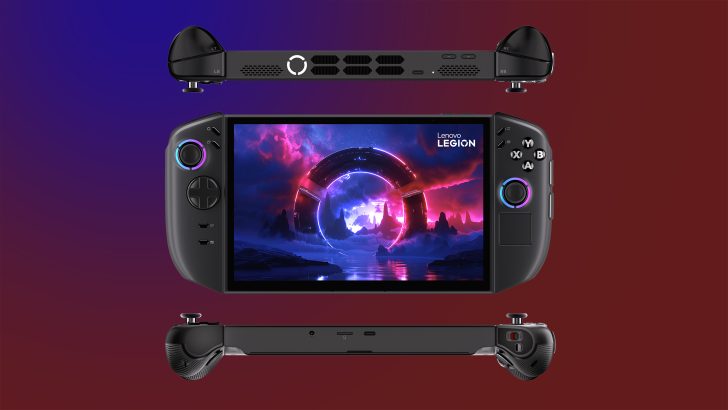
Lenovo Legion Go 2: A Serious Contender in the Handheld Gaming Market
Lenovo has officially confirmed the Legion Go 2, and the new handheld is shaping up to be far more than a minor refresh. While the original Legion Go made headlines as one of the first portable consoles to embrace AMD’s Ryzen Z1 Extreme chip, its successor doubles down on performance, versatility, and overall user experience. With stronger hardware, upgraded memory, and a host of refinements, Lenovo is aiming to make the Legion Go 2 a true alternative to the Steam Deck and ASUS ROG Ally.
One of the biggest improvements comes in the form of the new AMD processor options. Buyers can choose between the Ryzen Z2 and the Z2 Extreme, both designed for handheld efficiency but with very different architectural leaps. The standard Z2 uses AMD’s Hawk APUs based on Zen 4 CPU cores and RDNA 3 graphics, while the Z2 Extreme jumps to Zen 5 paired with RDNA 3.5 graphics. Both offer 8 cores and 16 threads, but the Z2 Extreme’s newer foundation means faster responsiveness and stronger graphical output. With 16 compute units clocked up to 2.9 GHz, this chip could easily push beyond what most handheld gamers have come to expect.
Display technology has also taken a major leap. Lenovo has swapped out the older IPS panel for a 1200p OLED screen, supporting up to 144Hz refresh rates and HDR with 500 nits brightness. That means richer blacks, higher contrast, and a smoother feel in fast-paced games. While resolution is technically lower than the 1600p on the first Legion Go, the OLED panel more than compensates by delivering better colors, reduced ghosting, and native landscape orientation for games. This change reflects Lenovo’s decision to prioritize visual fluidity and playability over pure pixel density.
Memory and storage also see significant upgrades. The Legion Go 2 now packs up to 32 GB of LPDDR5X-8000 memory, compared to the previous max of 16 GB at 7500 MHz. This boost allows for better multitasking, smoother streaming, and future-proofing against heavier games. Storage is equally generous, offering a 1 TB PCIe SSD by default, with the option to expand up to 2 TB via microSD cards. Gamers with massive libraries will find it far easier to store and juggle AAA titles without compromise.
Cooling is another area Lenovo has reworked from the ground up. The Legion Go 2 features a larger fan system with enhanced airflow and dual exhaust vents, positioned at both the bottom and back of the device. Lenovo claims users will even have the ability to manually adjust fan speeds, catering to those who want quieter sessions or maximum cooling performance. For a handheld that’s pushing far more power, this redesign could be the key to maintaining stability during long play sessions.
Perhaps the most noticeable lifestyle upgrade comes in the form of the battery. The original Legion Go shipped with a 49.2 Whr unit, but the new model jumps to a substantial 74 Whr pack. Paired with a 65W fast charger, this increase should extend gaming sessions without tethering players to a power outlet too often. Considering how demanding modern handheld hardware can be, this change may turn out to be one of the most important quality-of-life features of the Go 2.
As for design, Lenovo hasn’t abandoned the modular flexibility of its first entry. The detachable joysticks remain, supporting multiple modes of play: handheld for portable gaming, docked for a console-style experience, or the FPS stick mode for mouse-like precision in shooters. It’s a 3-in-1 design philosophy that sets the Legion Go apart from some rivals, especially those with more rigid control setups.
The company has also refined connectivity and extras. The Go 2 includes dual USB 4.0 Type-C ports with support for DisplayPort 2.0 and Power Delivery 3.0, a microSD slot, and a 3.5mm headphone jack. A fingerprint reader has been added for quick logins, a small but welcome touch that hints at Lenovo’s intent to blur the line between gaming device and productivity tool.
Pricing and availability remain unconfirmed, though history offers some clues. The original Legion Go debuted around $749–$799, so it’s reasonable to expect Lenovo will keep the Legion Go 2 in a similar bracket. Given the upgrades in nearly every department, the value proposition may be even stronger this time. With the handheld gaming market heating up thanks to competition from Valve, ASUS, and others, Lenovo appears ready to make its boldest move yet.
Ultimately, the Legion Go 2 seems to represent a careful balance of raw performance, design refinement, and practical upgrades. From its OLED display to its massive battery and next-gen AMD chips, Lenovo is sending a clear message: handheld gaming is no longer about compromises, and the Legion brand wants to lead that charge.
2 comments
gonna wait for reviews, Lenovo software support can be hit or miss tbh
oled at 144hz on a handheld… bruh that’s insane if it actually delivers smooth gameplay