NVIDIA is once again moving at a blistering pace, preparing to roll out its next-generation Rubin architecture before the end of 2025. Barely six months after ramping up production of the Blackwell Ultra GB300, CEO Jensen Huang has confirmed that no fewer than six Rubin chips are already being taped out at TSMC. 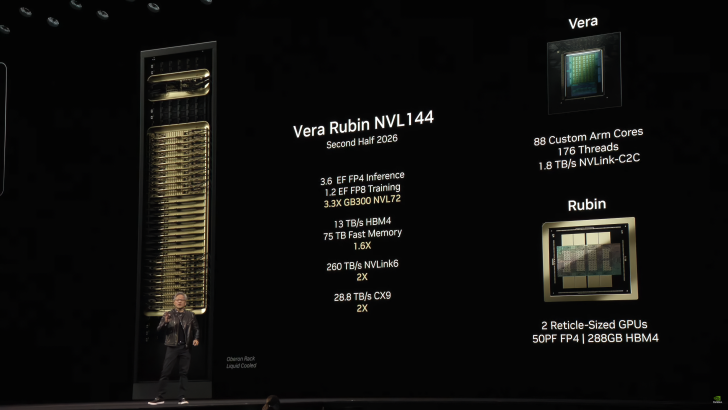
Analysts suggest that fully functional silicon could emerge from TSMC’s fabs by year-end, setting up Rubin for customer deployment sooner than many expected.
The Rubin family, named after pioneering astronomer Vera Rubin, is being described as NVIDIA’s boldest leap yet. It combines CPU and GPU technology built on TSMC’s N3P process with advanced CoWoS-L packaging, while its I/O dies will use N5B alongside cutting-edge 12-Hi HBM4 memory stacks. Crucially, Rubin introduces a true chiplet-based design across both GPUs and CPUs – NVIDIA’s first ARM-based CPUs to adopt this approach. This shift signals not just an incremental upgrade but a ground-up rethinking of how NVIDIA approaches AI silicon.
For customers, this could mean a performance-per-watt leap similar to the shift from Ampere to Hopper, with demand expected to mirror that historic surge. Analysts argue that Rubin’s arrival will lock NVIDIA into a cadence that competitors like AMD and Intel will struggle to match, especially since Rubin is tied closely to NVIDIA’s software ecosystem, a proven moat in the AI compute market. With Huang estimating that AI infrastructure could expand into a $3–4 trillion industry, Rubin is being positioned as a cornerstone of NVIDIA’s strategy to dominate the next wave of growth.
For TSMC, the challenge is just as significant. The foundry will be handling every step of Rubin production, from wafers to packaging, at a time when global AI demand shows no sign of slowing down. Whether rivals can answer with their own N3P or beyond designs remains to be seen, but for now, NVIDIA’s Rubin platform sets the tone for the AI arms race heading into 2026.
2 comments
too strong, too quick, too smart 🤯
bro the jensen worship is wild… amd and nvidia both on same cadence if u think abt it